
Magnetic Resonance Imaging
Advanced MRI Imaging For Accurate Diagnosis
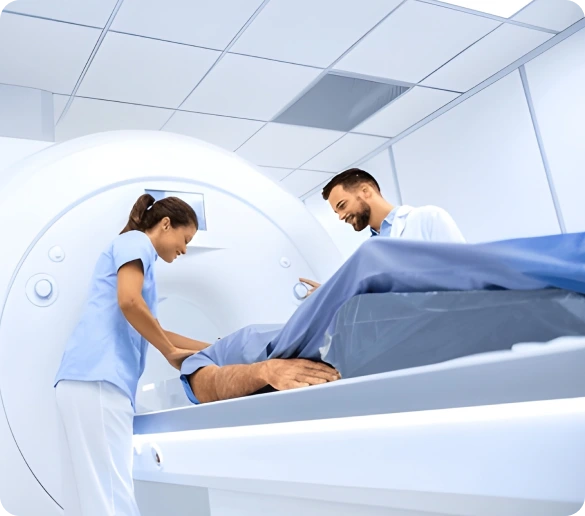
Rather than radiation, MRI relies on a magnetic field to render soft tissue in fine detail, which makes it the sharpest tool for assessing brain, spine, joints and ligaments. A board-certified radiologist interprets every RapidRad study.
Zero radiation involved
30 to 60 minute scan
Results in 24 hours
Sedation on Request
24 hr
Typical report turnaround
What an MRI shows
Detailed Soft Tissue MRI Without Radiation
The scanner combines a powerful magnet with radio wave pulses to assemble sectional views of the body. Since it responds to water content within tissue instead of density, it reveals considerably more in nerve, cartilage, muscle and brain tissue than either CT or X-ray manages.
For that reason, physicians turn to MRI whenever they need to examine anatomy that other imaging leaves ambiguous.
Conditions an MRI commonly evaluates
Studies With Contrast and Without
Certain exams call for gadolinium delivered by IV, which brightens vessels, inflamed tissue and particular tumors on the images. That decision belongs to the doctor writing your order. When contrast is included, we check kidney function beforehand and walk you through each step first.
Open MRI and wide bore options
Feeling boxed in during a standard scan does not have to be part of the experience. The wide bore machines here open up considerably more space near your head and shoulders without sacrificing any diagnostic clarity. Patients with serious claustrophobia can coordinate oral sedation through their physician ahead of time.
MRI at a glance
Scan time
30 to 60 minutes
Radiation
None
Referral
Required from your physician
Report turnaround
Typically 24 hours
Self pay pricing
Published, no hidden fees
Insurance
Most major plans accepted
Full range of imaging services
Whatever study your doctor orders, we perform it here
Magnetic imaging with zero radiation, delivering the sharpest soft tissue detail obtainable anywhere.
Brain MRI
Detailed brain imaging for stroke, tumors, MS lesions and unexplained headaches.
Spine MRI
Discs, nerve roots and spinal cord mapped for back pain, sciatica and stenosis.
Musculoskeletal MRI
Ligament, tendon, meniscus and cartilage detail for knee, shoulder and joint injuries.
Full Body MRI
A broad preventive survey covering head, chest, abdomen, pelvis and spine in one session.
Breast MRI
The most sensitive breast imaging available for high risk screening and cancer staging.
Cardiac MRI
Heart muscle, chamber volumes and scar tissue measured with reference standard accuracy.
Abdominal MRI
Liver, pancreas and kidney lesions characterised in detail CT often cannot reach.
Pelvic MRI
Uterus, ovaries and pelvic soft tissue mapped for fibroids and endometriosis.
Prostate MRI
Multiparametric imaging that locates significant cancer before any biopsy needle.
Why patients choose RapidRad
Accessible Imaging for Your Diagnostic Needs
This center was shaped around the four hurdles patients mention most: price, insurance, availability and nerves.
Pricing
Affordable rates
Straightforward costs on every study, nothing buried in the fine print. We walk you through affordable paths before anything is scheduled.
Insurance
Broader plan acceptance
Our network spans many carriers and our team confirms your benefits and clears up questions well before you arrive.
Availability
Scheduling that adapts
Mornings, evenings and weekend slots at participating centers, with visits kept brief so your day stays intact.
Comfort
Support for nervous patients
Sedation is offered to anyone uneasy about enclosed scanners and someone stays with you throughout the process.
Equipment
MRI built for range
Scanners capable of straightforward and difficult cases alike, delivering the sharp detail doctors rely on to act.
Communication
Bilingual staff
Nothing about your scan, your findings or your follow up should get lost because of the language you speak.
Before your appointment
Preparing for your MRI in four steps
MRI asks little of you beforehand, but the safety screening is the exception. Magnets and metal are a combination we take seriously.
Complete safety screening
Report any pacemaker, implant, stent, surgical clip, insulin pump or embedded metal fragment. Certain devices scan safely and others cannot, which is why this conversation happens before we hold your slot.
Eat and take medication normally
Fasting is not required for most MRI studies. Abdominal and pelvic exams are the exception, and our team will tell you when booking whether yours needs an empty stomach.
Leave the metal at home
Choose soft clothing free of zippers, snaps or underwire. Leave rings, watches and hairpins at home. Gowns and a locked storage space are available if you need them.
Arrive fifteen minutes early
Bring your order, photo ID, insurance card and any earlier scans on disc. Those fifteen minutes handle registration so your scanner time is not spent on forms.
Nearby and easy to reach
Imaging center built around Houston neighborhoods
We place our centers near the neighborhoods our patients call home, so quality imaging never costs you an afternoon of driving.
Montgomery, TX
|
Address: |
18057 HWY 105 suite 250 |
|
Phone: |
(832) 356-0730 |
|
Hours: |
Monday Sunday |
Common questions
MRI questions patients ask most
Ready to schedule your MRI.
Forward your referral and we will check your benefits, lock in your appointment and explain precisely what preparation is needed.