Computed Tomography
Advanced CT Imaging For Accurate Diagnosis
A CT scanner circles the body with X-ray beams and stacks the results into layered images, delivering in minutes what other studies need far longer to produce. Every RapidRad scan is interpreted by a board certified radiologist.
Scanning Takes Minutes
Reduced Dose Protocols
Contrast When Required
Results in 24 Hours
24 hr
Typical report turnaround
What an CT Scan shows
Layered cross sections that reveal bone, blood and organs
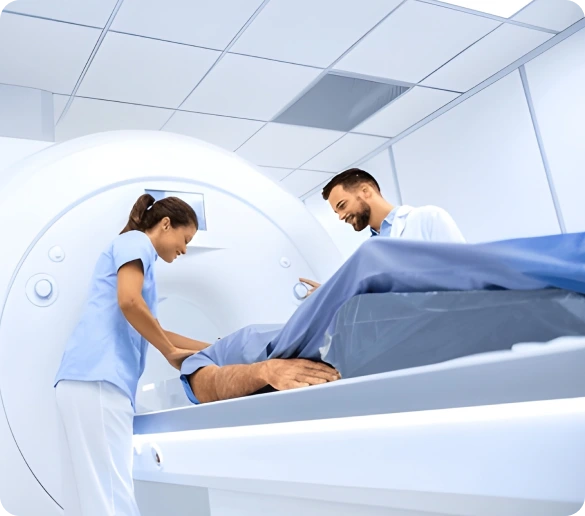
An X-ray tube rotates around you while detectors capture readings from hundreds of angles and software assembles those readings into thin slices of anatomy. Stacked together, those slices let a radiologist travel through the body one millimeter at a time.
Speed is what separates CT from other imaging, which is why physicians reach for it when the answer cannot wait.
What physicians order a CT scan to investigate
Studies with contrast and without
Many exams call for iodine based dye through an IV and some add an oral solution you drink beforehand, both of which sharpen the boundary between organs, vessels and abnormal tissue. Your ordering physician makes that call. When dye is planned, we review kidney function and allergy history first.
Keeping radiation exposure low
CT does use ionizing radiation and we take that seriously. Our protocols are set to the lowest dose that still answers the clinical question, adjusted by body size and scaled down further for younger patients. If you have had recent imaging elsewhere, tell us so we avoid repeating a study you do not need.
CT Scan at a glance
Scan time
Under 5 minutes typically
Radiation
Low dose protocols used
Referral
Required from your physician
Report turnaround
Typically 24 hours
Self pay pricing
Published, no hidden fees
Insurance
Most major plans accepted
Full range of imaging services
Whatever study your doctor orders, we perform it here
Rapid cross-sectional imaging that excels at bone, bleeding and sudden abdominal complaints.
CT Scan Without Contrast
Kidney stones, head bleeds and bone injury imaged in minutes with no dye or IV.
CT Angiography (CCTA)
Arteries mapped with timed contrast, showing narrowing, aneurysm and clots without a catheter.
High-Resolution CT Scan
Ultra-thin lung slices that reveal fibrosis, bronchiectasis and interstitial disease patterns.
CT Enterorrhaphy
Small bowel imaging for Crohn disease, strictures and bleeding endoscopy cannot reach.
CT Scan with Guided Biopsy
Precise needle sampling of deep lesions through a small nick rather than an incision.
Cardiac CT Scan
Coronary calcium scoring that turns your heart risk into a number in under fifteen minutes.
CT Urography
Kidneys, ureters and bladder scanned and imaged in timed phases for blood in the urine.
CT Lung Screening
Annual screening that finds lung cancer years before symptoms in eligible smokers.
Abdominal CT Scan
Every abdominal organ is captured in one pass for pain, obstruction and appendicitis.
Why patients choose RapidRad
Accessible Imaging for Your Diagnostic Needs
We built this center around the four things CT patients worry about most: the price tag, the coverage, the wait for a slot and the radiation.
Cost
Affordable rates
Honest figures on every CT study, with no charges buried in the fine print. We discuss affordable routes before anything gets booked.
Coverage
Broader plan acceptance
A broad carrier network sits behind us and our staff verify benefits and resolve authorization requirements before you arrive.
Access
Scheduling that adapts
Same week CT slots at participating centers, scheduled tightly enough that most patients are finished within half an hour of arriving.
Comfort
Dose kept as low as possible
Protocols are tuned to the smallest exposure that still answers your doctor's question, adjusted by body size and lowered further for children.
Care
Scanners built for speed
Fast acquisition handles trauma and routine follow up equally well, giving radiologists the crisp detail that urgent decisions depend on.
Technology
Bilingual staff
Instructions, contrast questions and follow up steps should never get lost because of the language you speak at home.
Before your appointment
Four things to handle before your CT scan
CT preparation depends almost entirely on whether contrast is ordered. If dye is part of your study, a few extra steps apply beforehand.
Tell us about allergies and kidney history
If your study includes iodine contrast, we need to know about previous dye reactions, kidney disease or dialysis. A recent creatinine result may be requested before we clear you for the exam.
Follow the fasting instructions given
Scans without contrast place no limits on eating. Contrast studies usually ask for four hours without food. Keep taking prescribed medications with small sips of water unless told otherwise.
Allow some extra time for oral contrast
Some abdominal exams require a solution you drink well ahead of scanning. When yours does, plan to arrive one to two hours early so it can travel through properly.
Bring your paperwork and prior scans
Have your referral, identification, insurance card and any earlier CT or MRI discs with you. Comparing previous imaging often sharpens the radiologist's reading considerably.
Nearby and easy to reach
Imaging center built around Houston neighborhoods
We place our centers near the neighborhoods our patients call home, so quality imaging never costs you an afternoon of driving.
Montgomery, TX
|
Address: |
18057 HWY 105 suite 250 |
|
Phone: |
(832) 356-0730 |
|
Hours: |
Monday Sunday |
Common questions
CT Scan questions patients ask most
Ready to schedule your CT scan?
Send us the referral and we will verify your coverage, secure a time and tell you exactly how to prepare for the study.